

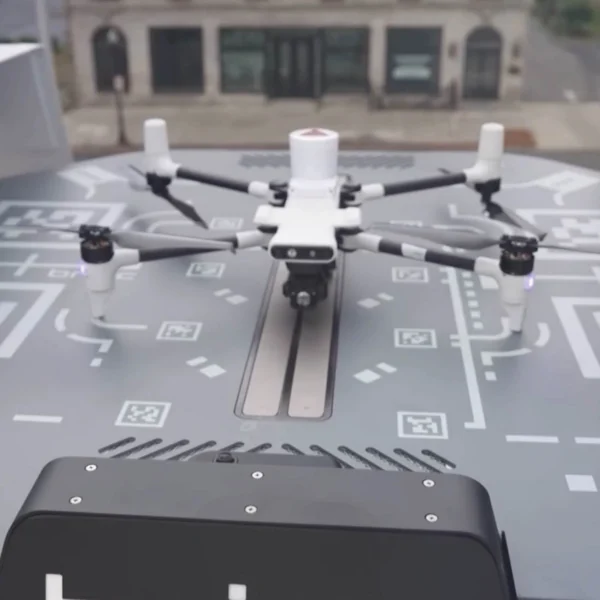
One of the new drones used by the Lima Police Department. (Spectrum News 1/Corey O’Leary)
To see the Lima Police Department’s new drone system, look to the roof of their fire station.
“They respond, like you can see, from these pods here, and they’re more web-based to where we can fly them from a computer inside,” said Lt. Ben Thompson with the Lima Police Department.
The department is one of eight agencies that are part of the Ohio Department of Transportation’s Drone First Responder pilot program, which reimbursed selected agencies around Ohio to get new, advanced drone systems.
“They provide aerial coverage so we can tell officers what’s going on the street from up above and we have a bigger picture,” Thompson said.
Unlike other drones, officers can launch them completely remotely and don’t have to maintain a line of sight on them. This allows them to quickly deploy the drones.
“They can fly anywhere in the city from a computer screen.”
The drones live in air-conditioned pods on the roof and are ready to launch at any moment. Down in a control room at the station, officers can launch the drone with the click of a button. Thompson says the drones have advanced radar capabilities, which allow them to detect other flying vehicles, like helicopters, and avoid collisions.
Once the drones are in the air, the operator in the control room gets a live feed of video from the drones. Officers can either type in an address or click a place on the map, and the drone will head there. Officers on the ground and 911 dispatchers can also pull up a live feed on their phones and computers.
“If we have a call with a guy with a gun, they can get there to see what this guy looks like, where’s he headed, so that way if he absconds before we get there we can know where he is and catch him to make the neighborhood safe,” Thompson said.
Thompson also mentioned that the drone can be used in hostage situations, where a speaker in the drone can be used to communicate. The drones are also equipped with thermal vision cameras to help responders locate people in an area that might be obscured. Thompson also said the drones could be used to quickly go to the scene of a car crash to survey the incident.
“There are other scenarios like search and rescue,” said Brianna Badanes, a spokesperson for Drive Ohio, an initiative under the Ohio Department of Transportation that is running the pilot program.
The agencies selected weren’t all police, they also went to fire departments and emergency medical responders. The agencies who are participating in the grant are:
- City of Springfield Police/Fire/EMS
- Athens Police Department
- Lima Police Department
- Toledo Police Department
- Violet Township Fire/EMS
- Austintown Fire Department
- City of Hamilton Police/Fire/EMS
- Amherst Police Department
- Kelleys Island Fire/EMS
The pilot program was created under Ohio House Bill 96 and allocated $2 million to reimburse those eight departments for their drone systems for two years. Badanes said ODOT will be collecting data from the eight agencies to create a report to present to lawmakers.
“If the legislature decides to commit more funding in the future to expand the program, we will definitely support it as directed,” Badanes said.
The Lima Police Department went with a drone company named Brinc, but departments could select two other companies, one named Skydio and another named Parrot.
For the first part of the year, the police department was getting the technology installed and training officers on how to use it. So far, the drones have only been in use for a short time.
“We’ve had a couple car break-ins and they’ve been used for trying to find the subject,” Thompson said.
Thompson also emphasized that they will only be used to respond to situations, not for other types of investigative police work.
“We’re not going out and spying on people; I guess that’s what people are most worried about. We can’t do that; it’s against the Fourth Amendment. We’re only going to go out if we have a call for service,” Thompson said.
He said typically drones can usually get to a scene of a crime or an accident before any officers can.
“They’re faster because they can go as the crow flies down city streets,” Thompson said.
It’s a new program, but if it’s successful, more police and fire stations across Ohio could adopt similar technology.
Soaring to new heights, together.
Be sure to visit the BWU Technology Partnerships Initiative website to learn more about how our NEOFIX program drives economic growth, promotes policy and infrastructure to improve drone safety and efficiency in various industries, and ensures that drone technology is being used responsibly.