

It was a text from his wife that changed the course of Thomas Taconet’s life.
“So I was sitting in my office in 2015 and I got a text from my wife, and it says, ‘Hey, here is your retirement plan,’” Taconet recalled. It was an article about the coming drone revolution.
Shortly after, he got his commercial drone pilot license, and with the encouragement of family, he started investigating how drones can be used for agriculture.
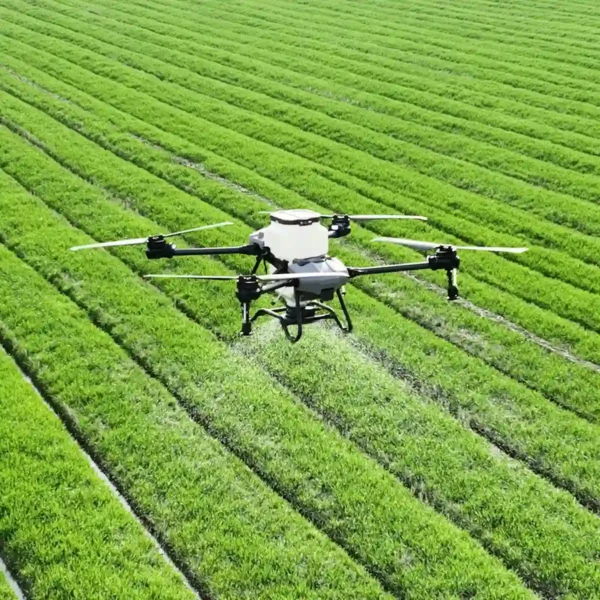
Taconet started Avon UAS, a small business that provides a variety of drone services to farmers.
“[I] got a drone to do agricultural mapping and did that for a while, but people are much more interested in the spraying. I mean, it’s just a bigger, sexier drone,” Taconet said.
He spent roughly $28,000 investing in a specialty drone that can help farmers spray their crops, which weighs 232 pounds when fully loaded with product.
“I’m using garlic as a deterrent for the chestnut weevil, which is the main insect that likes chestnuts,” explained Alan Apelt, owner of Buckeye Chestnuts, a small orchard near Cleveland Hopkins Airport.
Apelt says he was having workers hand-spray the trees before finding Avon UAS.
“It’s much faster with a drone and much better,” Apelt said.
“We’re not trying to take business away from the crop dusters, we’re trying to fill in gaps that they can’t cover, offer the services to smaller farms that normally couldn’t get the service of manned aircraft,” explained Taconet, saying that drones offer distinct advantages that can benefit small farms specifically.
Taconet explains that an important benefit of drones is their ability to treat very specific areas of a farm, rather than spraying the entire field. It’s known as precision agriculture, and the idea is to use a scalpel instead of a knife for chemical applications.
“Maybe they don’t need to treat their entire field; they only have to treat 50% of it. That’s 50% less input costs, which go to their bottom line, that means less potential run-off into the environment. And that’s where we are trying to get to. Get to ways to increase their yields, or at least hold them steady, while minimizing their costs,” Taconet said.
He says drone mapping can help identify the needs of the crops in specific areas, and the ability to pre-program the drones’ flight paths and sprayers allows for custom application. In addition to spraying fungicides and insecticides, he says the drones can be filled with seeds as well and used to grow cover crops.
“They’ll throw something like winter wheat or rye or barley,” Taconet said.
He’s just a one-man band and has spent significant time and money to invest in this business, which he says so far he’s been able to recoup what he’s invested.
“I think this year might be the first year I actually show a profit.”
Soaring to new heights, together.
Be sure to visit the BWU Technology Partnerships Initiative website to learn more about how our NEOFIX program drives economic growth, promotes policy and infrastructure to improve drone safety and efficiency in various industries, and ensures that drone technology is being used responsibly.